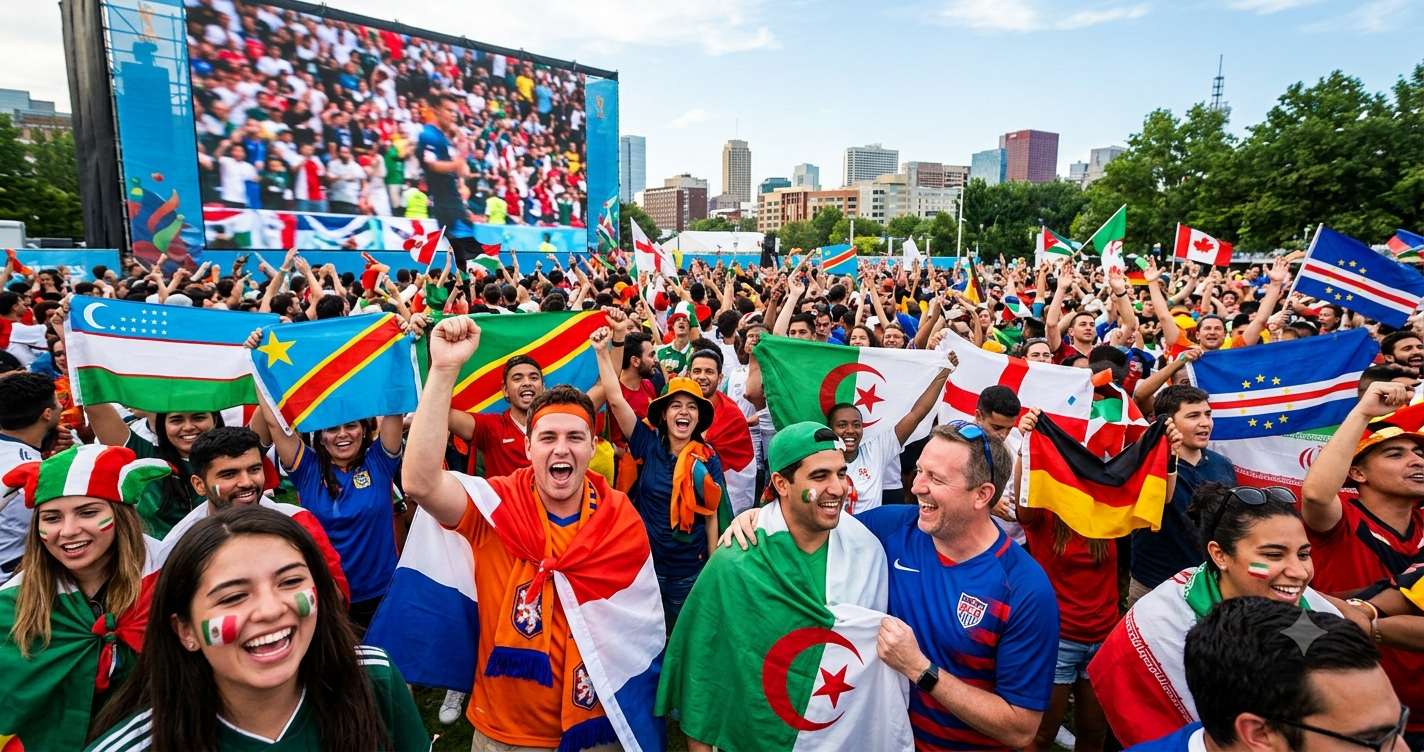
For five weeks, something remarkable has been happening across the United States, Mexico, and Canada. Forty-eight nations arrived for the first World Cup ever hosted by three countries — and what unfolded off the pitch may outlast anything that happened on it.
At Unieros, we've always believed that food, music, and shared celebration can dissolve borders faster than any policy ever will. This tournament proved it on a continental scale. Before the final whistle blows this Sunday, July 19, here are the cultural moments worth remembering.
When Kansas Fell in Love with Algeria
Lawrence, Kansas — a college town of about 100,000 people — became the unlikely heart of North African football this summer. When Algeria chose the city as its base camp, residents didn't just tolerate their guests. They adopted them. Hundreds gathered outside the team hotel on arrival night. Training sessions filled with local families waving Algerian scarves. Algeria's coach admitted the welcome gave him goose bumps.
Algeria went home in the round of 32. The friendship stayed. That's the quiet magic of a World Cup: a community in the American heartland now carries a piece of Algiers in its story, and 48 million Algerians know the name of a Kansas college town.
Culture in the Stands
Every nation brought more than a squad — they brought themselves.
Uzbekistan, appearing at its first World Cup since independence in 1991, celebrated with riders on horseback, a nod to the equestrian traditions at the center of Uzbek heritage. DR Congo's most famous supporter stood motionless through entire matches, one arm raised — a living tribute to Patrice Lumumba, the country's first prime minister after independence. Cape Verde made its tournament debut while viewing centers on São Vicente island erupted with every touch.
And the watching world watched everywhere: rooftops in Istanbul's historic Yedikule fortress, a book garden in Tehran, coffee shops in Cairo and Aden, and fans perched in trees in Port-au-Prince cheering on Haiti. Same game, ten thousand different living rooms.
The Exchange Went Both Ways
Visiting fans didn't just bring culture — they collected it. Dutch supporters turned a Texas Dutch Bros coffee shop into an orange sea for the simple joy of the name. England fans adopted the Atlanta Braves between matches. A German fan went viral after his life-changing first taste of ranch dressing (he's taking two bottles home).
Meanwhile, host cities leaned into their own diversity. Philadelphia's fan festival — running alongside America's 250th anniversary celebrations — rotated food trucks from the city's immigrant communities, serving global flavors next to cheesesteaks. In San José, Little Saigon's Grand Century Mall is hosting its own final-day watch party, because the world's game belongs in every neighborhood.
Why This Matters Beyond Football
A World Cup compresses what usually takes generations: strangers becoming neighbors, unfamiliar flags becoming familiar faces. For one summer, a Bosnian goal was celebrated in Sarajevo and in a Toronto fan zone at the same moment. A Haitian save mattered in Port-au-Prince and in Brooklyn.
This is the one-love philosophy we've built Unieros around for more than twenty years: you don't need to share a language to share a celebration. You just need a reason to gather — and maybe a screen, some good food, and somebody new sitting next to you.
Catch the Final Together
The final kicks off Sunday, July 19. Wherever you are, resist the urge to watch alone. Find a fan festival, a neighborhood watch party, a friend's living room with an unfamiliar flag on the wall. Ask someone why they love their team. That conversation is the real trophy.
One world. One game. One love.
Want more cultural connection in your inbox? Join the Global Culture Circle and grab our free Global Culture Planner.
The Final Whistle Is Just the Beginning.
Where are you watching from?
Join fans watching from homes, cafés, parks, villages, and city squares around the world.
Global Participation
2
fans joined
2
countries
- North America1
- Africa1
Top locations
Fans have joined from 2 countries across North America, Africa.
How the World Is Watching
Stories from fans, families, and communities across the globe.
Nairobi, Kenya
Miami, United States
Nairobi, Kenya
Miami, United States
Continue Your 2026 World Cup Final Journey

One Match. One World. Where are you watching from?
A photograph of Messi and a six-month-old Lamine Yamal, and what it means to watch this final together.

We Went Global While Staying Local — And It Was Everything
A weekend visiting 10 embassies in DC — tasting food, experiencing culture, and connecting with communities.

One Love, One Mission: Supporting Jamaica's Recovery
Twenty years of Unieros connecting people across differences — from Haiti to Japan to Jamaica.

20 Years of Unieros: Building Resilience Through Diversity
Two decades of a multicultural movement connecting culture, technology, and community.